
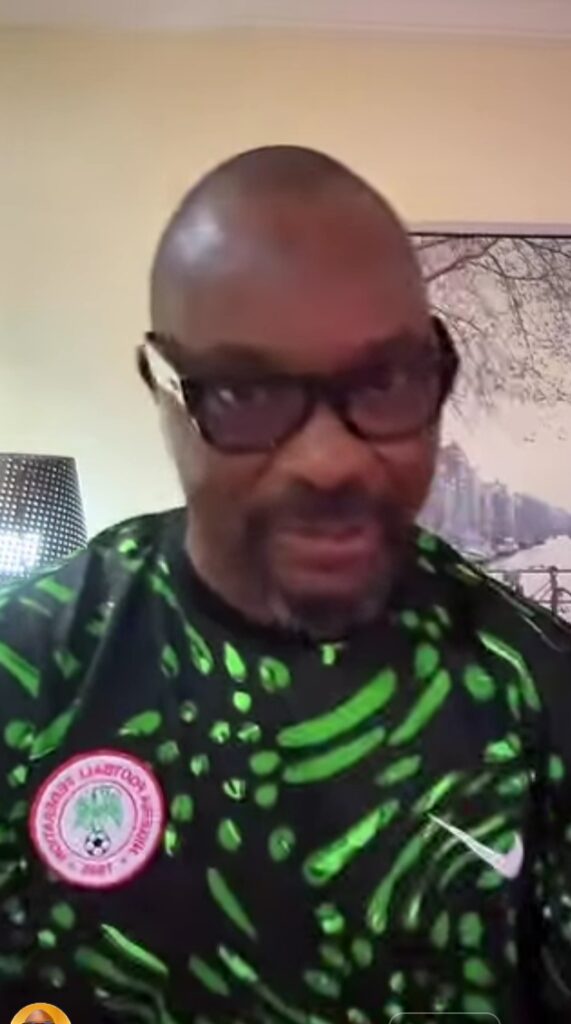
Fayose Isaac , a Nigerian businessman, social commentator, and younger brother of former Ekiti State governor Ayodele Fayose, has once again sparked widespread debate online with a viral video commentary linking football drama to Nigeria’s deeper social and political challenges.His comments were inspired by the dramatic events of the 2025 Africa Cup of Nations (AFCON) final, which took place on January 18, 2026, in Rabat, Morocco. Senegal defeated the host nation 1–0 after extra time, with Pape Gueye scoring the decisive goal. However, the match is now remembered less for the football and more for the chaos that unfolded late in the game.In stoppage time of normal play (around the 98th minute), with the score still 0–0, referee Jean-Jacques Ndala Ngambo of the Democratic Republic of Congo disallowed a late Senegal goal for a perceived foul. Moments later, after a VAR review, he awarded Morocco a highly controversial penalty for a foul on Brahim Díaz. Senegal’s players were outraged, especially as their own disallowed goal was not subjected to the same review.Acting on the instructions of head coach Pape Thiaw, Senegal’s players briefly walked off the pitch in protest. The match was delayed for about 14 to 16 minutes amid rising tensions, on-field confrontations, and unrest in the stands, including reports of Senegalese supporters attempting to invade the pitch. FIFA President Gianni Infantino later condemned the scenes as “unacceptable.”Senegal eventually returned to the pitch reportedly after intervention from captain Sadio Mané. Brahim Díaz missed the penalty with a poorly executed Panenka, which was saved by goalkeeper Édouard Mendy. The game then went into extra time, where Senegal scored and went on to secure victory.The incident triggered widespread outrage. CAF opened investigations, condemned attacks on match officials, and discussed possible sanctions against Senegal. Morocco’s football federation also threatened legal action, arguing that Senegal’s walkout influenced the outcome of the match.In a video posted around January 19, 2026 widely shared across Instagram, X (formerly Twitter), and Facebook, Fayose praised Senegal’s refusal to accept what they saw as injustice. He described their actions as proof of a “fighting spirit” and used the moment to criticize what he believes is a culture of passivity in Nigeria.According to Fayose, Nigerians too often accept unfair treatment from authorities, politicians, and institutions without resistance. Using football as a metaphor, he argued that Nigerians are frequently “pushed around,” fail to defend their rights, and lack the assertiveness needed to demand accountability, justice, and meaningful change. He also referenced past football-related incidents involving Nigerian teams abroad, including in Morocco, to support his claims.In his words, “Nigerians, have you seen the f!ght!ng spirit of Senegal? Give them the trophy! You saw what happened at the stadium. You saw it, didn’t you see it? The sparks on the field. But Nigeria’s football, emotion, anything goes. It’s the same thing that is happening to us in our country. Even our football on the field in Morocco anything goes. We are taking anything; anything that they put on us, we accept.You can see Senegal they fought for what belongs to them. The trophy didn’t come to them at that time. They fought for it; they didn’t accept it. They fought. They did their best. The spirit of Nigeria is “anything goes.” If they push us to the edge, we go. If they push us to the edge, we go. It’s the same thing that happened on the field.The fighting spirit in them is that they don’t accept just anything. But here in Nigeria, people are pushing us up and down. They already know our weakness. They know we cannot f!ght. We know what we are faced with.F!ght for your right and get off. You are on the floor. You cannot get off. You are holding onto the floor. The f!ghting spirit is your power. It is the same thing.The fıghting spirit is the spirit of the army. Come on, let’s fıght for them ourselves. Let’s fıght for peace. If you don’t fıght for peace, you don’t get peace. Come on!”His blunt remarks at times calling Nigerians “weaklings” or “mumu” have sharply divided opinion. Supporters see his comments as a necessary wake-up call encouraging resilience and collective action, while critics argue that he oversimplifies complex issues and ignores structural barriers such as repression, fear, and social division.Ultimately, Fayose’s message reflects a familiar pattern in Nigerian public discourse: using major sporting moments as mirrors for national character, leadership failures, and civic responsibility. In his view, Senegal’s refusal to “accept anything” demonstrates that resistance even when chaotic can produce results, while passive acceptance only deepens vulnerability at home and abroad.